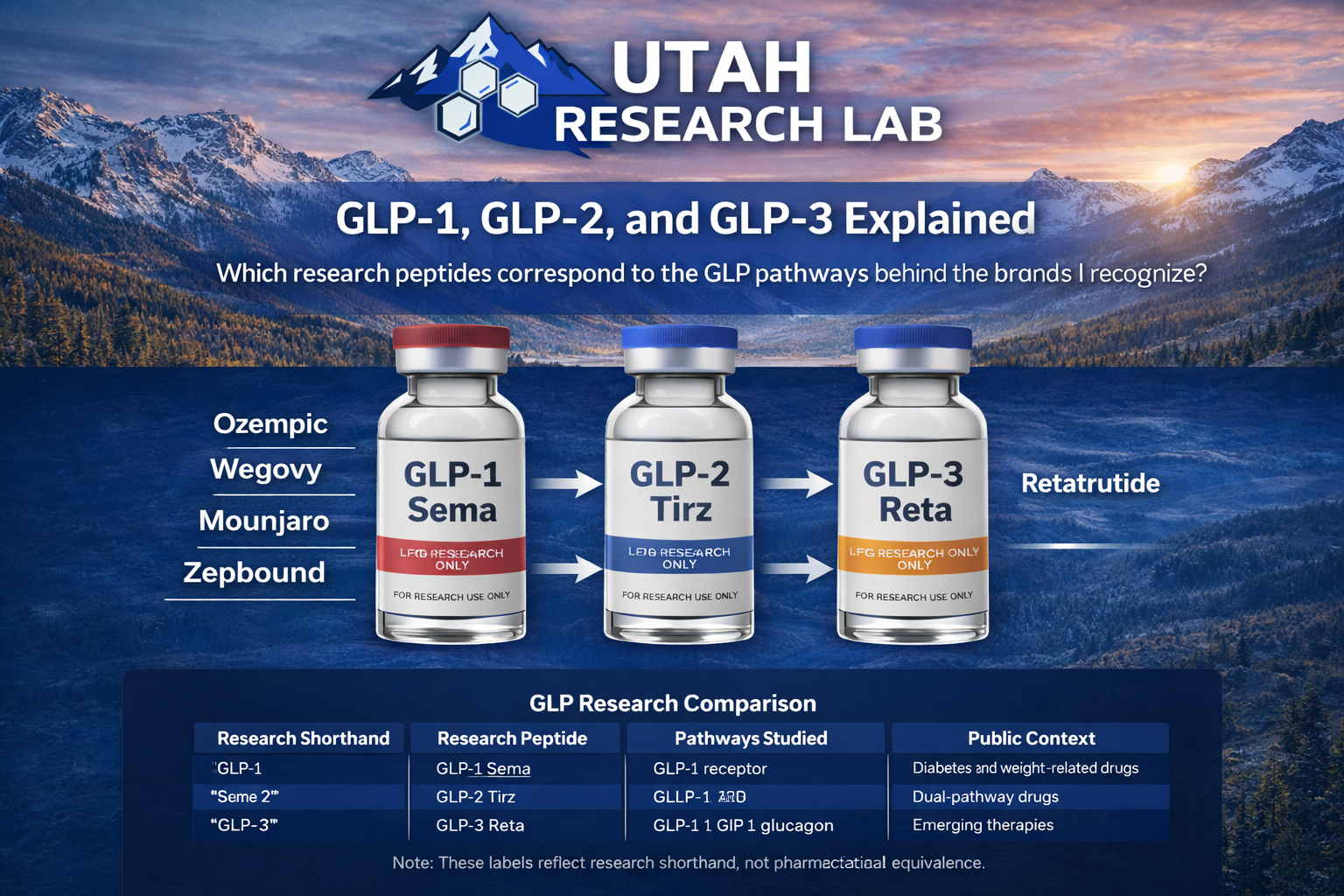
GLP-Related Research Explained: Pathways, Compounds, and Scientific Context
Interest in GLP-related research has increased significantly in recent years. For many, awareness of these biological pathways begins through widely discussed prescription medications. As a result, a common question arises:
Which research compounds correspond to the GLP-related pathways associated with well-known medications?
This article explains what glucagon-like peptides are, how different receptor pathways are studied, and how commonly referenced research compounds relate to those pathways—while clearly distinguishing laboratory research materials from prescription drugs.
What Does GLP Mean?
GLP stands for glucagon-like peptide, a group of naturally occurring peptide hormones involved in metabolic and digestive signaling.
The two primary endogenous hormones are:
- Glucagon-like peptide-1 (GLP-1)
- Glucagon-like peptide-2 (GLP-2)
These peptides act on different receptors and are involved in distinct physiological processes. They are not interchangeable and should be understood as separate biological systems.
Scientific Definitions vs Informal Research Terminology
Scientific reality:
- GLP-1 and GLP-2 are naturally occurring hormones
- They act on different receptors
- They serve different biological functions
Informal research terminology (commonly used in discussion):
- “GLP-1” → compounds studied for activity at the GLP-1 receptor
- “Dual agonist” → compounds studied for activity at both GLP-1 and GIP receptors
- “Triple agonist” → compounds studied for activity at GLP-1, GIP, and glucagon receptors
These terms are used to describe receptor activity and pathway targeting—not formal hormone classifications.
Why GLP Pathways Are Widely Discussed
GLP-related receptor pathways are the subject of significant scientific and clinical research. Public awareness has increased due to the use of certain prescription medications in regulated medical settings.
These medications are prescribed under medical supervision for specific indications. Their visibility has led to broader interest in the underlying receptor systems and how they function biologically.
Research Compounds vs Prescription Medications
It is important to distinguish clearly:
Research compounds are not prescription medications.
They are:
- Not approved for medical use
- Not intended for diagnosis, treatment, or prevention of disease
- Supplied strictly for laboratory research and in vitro study
While research compounds may be studied in relation to the same receptor pathways, they are not equivalent to regulated pharmaceutical products.
GLP-Related Research Compounds
Semaglutide — GLP-1 Receptor Agonist Research
Semaglutide is commonly studied for its interaction with the GLP-1 receptor in controlled laboratory environments.
Tirzepatide — Dual GLP-1 and GIP Receptor Agonist Research
Tirzepatide is studied for activity across both GLP-1 and glucose-dependent insulinotropic polypeptide (GIP) receptors.
Retatrutide — Triple Agonist Research (GLP-1, GIP, and Glucagon Receptors)
Retatrutide is studied for multi-receptor interaction involving GLP-1, GIP, and glucagon pathways.
Research Comparison Overview
| Compound |
Receptors Studied |
Research Focus Area |
| Semaglutide |
GLP-1 |
GLP-1 receptor signaling |
| Tirzepatide |
GLP-1 + GIP |
Dual receptor pathway research |
| Retatrutide |
GLP-1 + GIP + Glucagon |
Multi-receptor pathway research |
Note: These compounds are referenced for research context only and are not pharmaceutical equivalents.
Importance for Research Professionals
Researchers often encounter GLP-related terminology through public discussions before exploring the underlying science. Clear, accurate terminology helps:
- Distinguish receptor pathways and mechanisms
- Avoid confusion between regulated drugs and research materials
- Support informed decision-making in laboratory settings
Availability for Research Use
Compounds such as semaglutide, tirzepatide, and retatrutide are made available strictly for:
- In vitro research
- Laboratory-based study
- Non-clinical scientific investigation
All materials are designated for research use only and are not intended for human or animal consumption.
Final Thoughts
Understanding GLP-related pathways requires separating scientific terminology from informal discussion and public awareness. Using accurate compound names and clearly defining receptor activity supports responsible communication and better research outcomes.
As interest in these pathways continues to grow, clarity, transparency, and proper use designation remain essential.