


Interest in semaglutide has expanded rapidly across the United States—and Utah is no exception. From Salt Lake City to Provo, Ogden, West Jordan, Sandy, Lehi, and surrounding communities, awareness of GLP-1–related compounds has grown significantly.
From a scientific standpoint, semaglutide has gained attention due to its role in GLP-1 receptor activity and its evaluation in large-scale clinical trials.
This guide explains:
Semaglutide is a glucagon-like peptide-1 (GLP-1) receptor agonist.
GLP-1 is a naturally occurring hormone involved in:
Pharmaceutical formulations of semaglutide have received FDA approval for specific medical uses under physician supervision.
Semaglutide gained widespread recognition after large randomized clinical trials evaluated it for:
Clinical data demonstrated statistically significant improvements in glucose control and body weight outcomes when used under proper medical supervision.
As a result, semaglutide has become one of the most discussed GLP-1 receptor agonists in modern metabolic medicine.
This national visibility has also driven increased interest throughout Utah, where health-conscious communities actively follow advancements in metabolic research and wellness.
FDA-approved formulations of semaglutide are indicated for:
These medications require:
It’s important to distinguish between:
Each operates under different regulatory frameworks.
Beyond approved uses, GLP-1 receptor pathways remain a major focus of ongoing research.
Researchers continue to study:
This continued exploration fuels interest across research communities throughout Utah and nationwide.
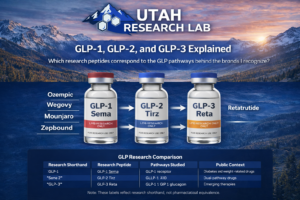
As research expands, semaglutide is often compared with other compounds such as:
Each compound interacts differently with metabolic pathways.
Understanding these differences is key for accurate scientific discussion, particularly when comparing mechanisms and outcomes.
Across Utah, interest in semaglutide continues to grow due to several factors:
Utah’s population tends to be proactive when it comes to health and performance, which naturally drives curiosity around emerging metabolic compounds.
This distinction is critical.
Prescription semaglutide:
Research-grade semaglutide:
Understanding this difference is essential for responsible discussion.
Is semaglutide available in Utah?
Yes, in clinical settings it may be prescribed by licensed healthcare providers based on individual evaluation and FDA-approved guidelines.
Is research semaglutide the same as prescription medication?
No. Research-grade materials are not the same as FDA-approved pharmaceutical products and are not intended for clinical use.
Why is semaglutide so widely discussed?
Large clinical trials and expanded FDA approvals have significantly increased awareness and media coverage.
Semaglutide represents one of the most extensively studied GLP-1 receptor agonists in modern metabolic research.
Across Utah, growing awareness reflects a broader interest in health, performance, and long-term wellness. As conversations continue to evolve, it’s essential to rely on accurate, science-based information.
Clear understanding—not hype—should guide any discussion involving metabolic research or therapies.